

Alexanders: Growing a Forgotten Vegetable as a Windowsill Crop,
Wicking Crop, and Future Food-Resilience Plant
Alexanders, Smyrnium olusatrum, is one of Britain’s forgotten vegetables. Most people now see it as a wild roadside or coastal plant, but historically it was grown and eaten as a food crop. It belongs to the carrot family, Apiaceae, and has been described as a Roman-introduced pot herb or “wild celery” once used before celery became common in gardens.
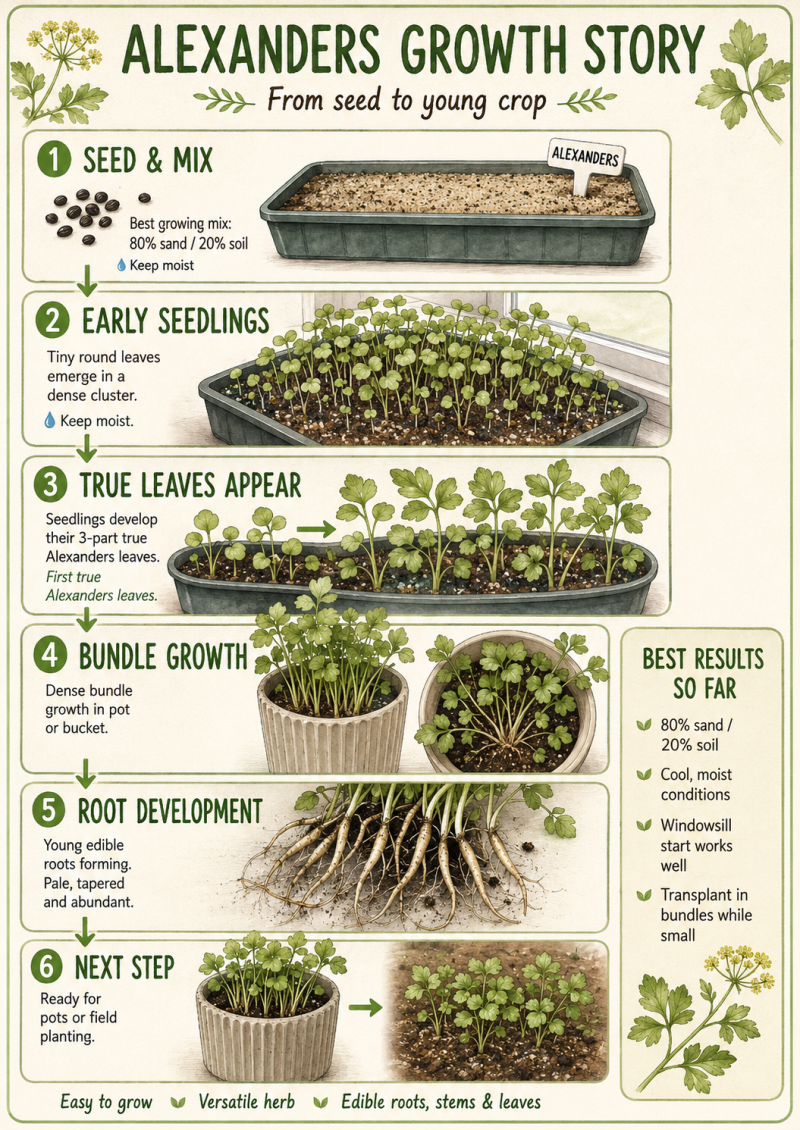
This blog documents my ongoing practical research into growing Alexanders from seed in small domestic conditions: windowsills, sand/soil trays, pots, buckets, and now a possible wicking or aquaponic-style system. Most public guides show mature Alexanders plants, but very little is shown about the first months of growth: the round seedling leaves, the first three-part true leaves, the young roots, and the stage before rust appears.
Why Alexanders matters now
As food costs rise and people become more interested in local resilience, forgotten vegetables deserve another look. Alexanders is not just a wild plant; it is a potential early-season green, root, spice, and herbal crop.
Scientific research has already investigated Alexanders as a neglected vegetable, including its ascorbic acid content, fatty acid composition, and nutritional value. This supports the idea that Alexanders deserves to be revisited as a serious food plant, not dismissed as a roadside weed.
Recent research also reports that Smyrnium olusatrum contains compounds of interest, including flavonoids, essential oils, and ascorbic acid. These compounds are linked in the wider research record with antioxidant, antimicrobial, anti-inflammatory, and antiparasitic activity.
This does not mean Alexanders should be presented as a cure. It means it is a plant worth studying properly.
My practical growing method so far
The first successful home method used a simple low-cost system:
1. Ripe black Alexanders seed was collected in late summer / early autumn.
2. Seeds were placed onto an 80/20 sand/soil mix in a small plastic container.
3. The container was kept moist on a windowsill.
4. The seedling roots expanded through the sand and soil, lifting the growing medium into a mound.
5. The seedling mat was later transferred into a larger pot or bucket.
6. The seedlings were allowed to grow together in a dense bundle before some were separated later.
This matters because Alexanders seedlings do not immediately look like the adult plant. In the first stage, they can look like small round-leaved “weeds.” Later, the true Alexanders form begins to appear: the leaves split into the familiar three-part shape.
This transition is important for identification, especially for people who want to grow Alexanders safely from seed rather than only identifying mature wild plants.
The first 6–9 months of growth
From the documented timeline, the plants appear to be in roughly two overlapping timelines:
- Seed collection to May: around 8–9 months from late summer/autumn seed collection.
- Visible seedling growth to May: around 5–6 months from the first clear seedling stage.
By May, the young plants have already formed recognisable roots. The roots are pale, tapered, and carrot/parsnip-like in miniature. This is significant because Alexanders roots are one of the parts of the plant traditionally described as edible when correctly prepared. At this stage the plant can be grown similar to cress type processes in the ground or in the pot, and cultivated as it continues to grow through the season. Even today in May 2026, the new growth of sees over a rotation period of planting is still growing despite wild crops now already starting to have the orange pests on the leaves, the new growth potted seeds have a healthy growth without pests. Making it a food source that does not require pesticides before it reaches just before flowering stages, plus a potential crop if manages within greenhouses could be a yearly growing vegatable.
In the pot, the seedlings appear to tolerate being close together while young. They grow as a tight group, almost like a living mat. This suggests Alexanders may be worth testing as a cut-and-come-again pot herb or early-stage leaf crop, rather than only being grown as a large biennial plant.
New hypothesis: Alexanders as a wicking crop
The next stage of my experiment is to test Alexanders in a wicking or semi-hydroponic system. I would not yet call it full aquaponics unless fish or nutrient water is included, but the principle is similar: water is held below, while the upper soil remains less waterlogged.
The working idea is this:
Alexanders may be able to grow as a cool-season wicking crop, with the lower roots drawing water from a reservoir while the upper crown and main root remain in drier, cleaner soil.
This may help the plant develop a drinking-root system downward, while reducing crown rot and keeping the edible leaf stage cleaner. The aim would be to harvest the young leaves and stems repeatedly, like cress, parsley, celery leaf, or microgreens.
Why harvest early? Beating Alexanders rust
A major issue with mature Alexanders is the appearance of yellow/orange spots or blisters. These are not simply insect damage. They are commonly associated with Alexanders rust, Puccinia smyrnii, a rust fungus that forms galls or blisters on the leaves and stems.
This creates a practical harvest marker:
- Before rust appears: young leaves are cleaner, milder, and more suitable for food use.
- Once rust appears: the plant is better treated as observation, seed, or non-food material rather than prime salad/herb crop.
The early-cut system may therefore have a double advantage: it could provide a fresh nutritious crop before the plant becomes affected by rust, and it may reduce reliance on mature leaves that often become damaged later in the season.
Potential nutritional value of young Alexanders
Published research already supports Alexanders as a neglected vegetable with nutritional value, including ascorbic acid and other plant compounds.
However, there appears to be a gap: I have not yet found public research specifically analysing young Alexanders shoots grown as microgreens, windowsill greens, or wicking crops.
That is where this project becomes interesting. The question is not simply:
“Is Alexanders edible?”
The better question is:
“What is the nutritional profile of Alexanders at the early seedling and young leaf stage, especially when grown in controlled windowsill or wicking systems?”
This matters because if the early leaves contain meaningful levels of vitamin C, minerals, flavonoids, antioxidants, or other useful compounds, Alexanders could become a practical household crop — especially in winter and early spring.
Traditional medicinal and anthelmintic interest
Traditional herbal sources describe Alexanders as a digestive herb, a plant used historically for stomach and urinary complaints, and an old antiscorbutic plant used by seafarers. Some sources also describe external uses for cuts, bruises, swellings, and skin issues.
The anthelmintic question is especially important. Modern papers and reviews discuss antiparasitic potential in plant compounds, including terpenes, flavonoids, and essential oils.
At this stage, the honest wording is:
Alexanders has traditional and biochemical reasons to be investigated for antiparasitic and anthelmintic potential, but controlled studies are needed before claims can be made for humans or animals.
Horses and seasonal craving
From practical horse experience, I have observed horses seeking certain herbs at particular seasons. Alexanders may be one of the plants worth documenting in this way, especially if horses show interest at times when parasite burdens are more likely to rise.
This does not yet prove an anthelmintic effect, but it creates a useful research question.
The question for future equine study could be:
Do horses selectively browse Alexanders at certain times of year, and does controlled inclusion of Alexanders leaf, stem, seed, or dried material affect gut health, parasite egg counts, or general condition?
This could open a second market: not just Alexanders for human kitchens, but Alexanders as part of a controlled equine herbal feed, pellet, or seasonal forage product — provided proper safety, dosing, and nutritional studies are completed first.
Potential crop model
There are several possible growing routes:
1. Windowsill greens — small containers for household use.
2. Wicking pots — repeated cut-and-come-again leaf harvests.
3. Allotment beds — leaf, stem, root, and seed production.
4. Temporary land cropping — using unused or fallow land before development.
5. Equine herbal crop — future pellet or dried forage ingredient if research supports it.
Any future discussion about large landholders or unused development land should be framed carefully as an opportunity model rather than a claim.
The idea is simple: land that is sitting unused for years could potentially grow low-input food or herbal crops while awaiting development, if permissions, soil safety, biodiversity rules, and commercial agreements are in place.
Proposed experiment: Stage 1 home trial
The next practical trial should compare three growing systems:
Batch A — Standard soil pot
Normal compost/soil pot. This is the control.
Batch B — Wicking pot
Soil above, water reservoir below, allowing roots to draw down.
Batch C — Sand/soil tray
Shallow 80/20 sand/soil tray, grown more like cress or microgreens.
Record for each batch:
- Date sown.
- Date germinated.
- Date first round leaves appear.
- Date first three-part true leaves appear.
- Root length and root thickness.
- Days after cutting until regrowth.
- Flavour.
- Leaf colour and gloss.
- Rust appearance date.
- Any mould, rot, insect damage, or collapse.
- Whether repeated cutting weakens or strengthens the plant.
Stage 2: research proposal
The next document after this blog should be a research proposal for universities, agricultural colleges, food-resilience groups, herbal medicine researchers, equine nutrition companies, or sustainable farming partners.
Suggested study title:
Nutritional, Antiparasitic, and Cultivation Assessment of Alexanders (Smyrnium olusatrum) as a Forgotten Vegetable and Controlled Equine-Herbal Crop
Possible study questions:
1. What nutrients are present in Alexanders seedlings, young leaves, stems, roots, flowers, fruits, and seeds?
2. Does the young cut-and-come-again stage retain meaningful vitamin C, flavonoids, minerals, or antioxidant activity?
3. Can Alexanders be grown reliably in windowsill, wicking, hydroponic, or low-input field conditions?
4. Does early harvesting reduce exposure to Alexanders rust?
5. Do Alexanders extracts show measurable antiparasitic or anthelmintic activity in lab assays?
6. Do horses voluntarily select Alexanders seasonally?
7. Could dried Alexanders be safely used in controlled equine feed or pellet form?
Stage 3: partnership routes
If nutritional and safety studies are positive, Alexanders could have several future routes:
- Forgotten vegetable revival.
- Local food resilience crop.
- Windowsill / balcony crop.
- Early spring “hungry gap” green.
- Herbal tea ingredient.
- Seed spice crop.
- Equine herbal feed research.
- Temporary land-use crop before development.
- Community garden and allotment crop.
- Educational crop for schools, foragers, and food security groups.
This project starts small: a windowsill, sand, soil, seed, pots, photographs, and careful observation. But the bigger question is serious:
Can a forgotten Roman vegetable become a modern food-resilience crop for humans and a researched seasonal herb for horses?
Closing note
This research is still in progress. The current evidence supports Alexanders as a historically edible and nutritionally interesting plant, but the young windowsill “cress stage,” wicking method, and equine-use possibilities need deeper testing.
That is exactly why this work matters. The gap is visible. The plant is growing. The next step is structured study.
Clean action plan from here
1. Publish the blog with photos and dates.
2. Create the research proposal with proper aims, methods, safety notes, and study questions.
3. Approach research groups, agricultural colleges, equine nutrition contacts, and farming partners.
4. Keep documenting the plant cycle through rust, flowering, fruiting, seed collection, and regrowth.
5. Test wicking pots against normal pots.
This is worth pushing properly. The power here is not just “Alexanders is edible.”
The power is this:
We are documenting a missing cultivation pathway for a forgotten vegetable, from seedling to crop system, with possible human nutrition and equine-health research value.ere to add text.
Create Your Own Website With Webador